The Sickness Absence Iceberg: Direct vs Indirect Costs
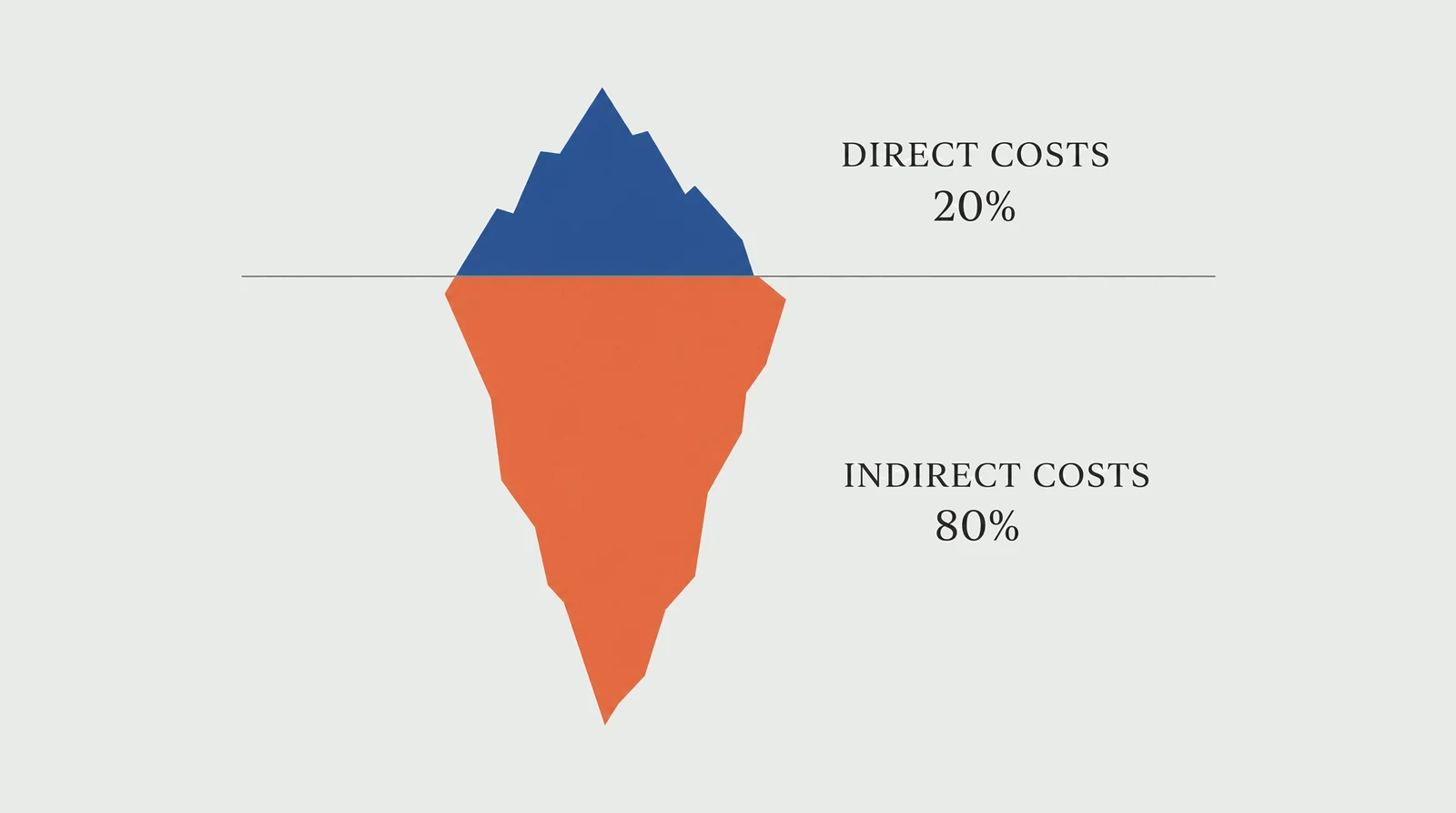
Your sickness absence report tells you a number. One-point-eight percent, three-point-two percent, whatever your organisation’s figure happens to be. The finance team can calculate what that costs in statutory sick pay, occupational sick pay, and temporary cover. That number will make it into a board report somewhere, probably in an appendix, probably noted without discussion. And that number represents perhaps twenty percent of what absence is actually costing your organisation.
The iceberg metaphor is overused in business writing, but it applies here with uncomfortable precision. Above the waterline: the direct costs, sick pay, temporary staff, overtime to cover absent colleagues, the administrative overhead of managing the absence process. These are straightforward to calculate, which is why they are the only costs most organisations measure. They are also the smaller part of the picture.
Below the Waterline
Below the waterline sit the indirect costs, and they are substantially larger: reduced productivity from remaining team members absorbing additional workload, missed deadlines and delayed projects, deterioration in service quality or customer experience, increased pressure on line managers who spend more time covering gaps and less time developing their people, the morale cost as teams watch colleagues burn out covering for absent peers, the reputational cost when external stakeholders experience degraded service, the recruitment cost when the stretched team eventually loses people who were not absent but become absent because the workload became unsustainable, the lost institutional knowledge when experienced people leave, and, at leadership level, the cost of decisions made under pressure by people who are covering multiple roles.
The Health and Safety Executive recorded 22.1 million working days lost to work-related stress, depression or anxiety in 2024/25. That is the direct cost, days not worked. The indirect cost, the downstream effects of those 22.1 million lost days on organisations already operating at capacity, is an order of magnitude larger and almost entirely unmeasured. For perspective, 22.1 million working days is roughly 96,000 people not working for a whole year.
When Low Absence Is a Warning Sign
In his board advisory work, Craig Fearn has repeatedly seen organisations that congratulated themselves on low absence rates while their employee engagement surveys, exit interviews, and informal feedback channels were screaming that the workforce was struggling. The absence rate was low because people felt they could not afford to be absent, not because they were well. This is the distinction that most absence reporting misses: is your absence rate low because your workforce is healthy, or is it low because your workforce is too scared, too pressured, or too under-resourced to stop? The first is a sign of organisational health. The second is a sign of an organisation burning through its human capital and mistaking the lack of visible flame for the absence of fire.
The CIPD’s Health and Wellbeing at Work survey has found presenteeism widely reported across UK organisations, people working while unwell because of workload pressure, job insecurity, or cultural expectations that absence signals weakness. Presenteeism does not appear in absence reports. It does not trigger the sick pay calculations. It is invisible to the systems designed to measure the problem. And it is often more damaging than absence, because a present-but-unwell employee can make errors, damage relationships, and perpetuate unsustainable norms for months before anyone notices, whereas an absent employee at least creates a gap that demands to be filled.
The Multiplier Every Board Should Apply
Here is a calculation every board should perform at least annually: take your sickness absence rate and multiply it by a factor of three to five for direct costs (replacement, overtime, management time) and by a factor of five to ten for total costs (adding presenteeism, reduced productivity, quality degradation, and reputational impact). The specific multiplier depends on your sector and the nature of your work, knowledge-intensive organisations sit at the higher end because the gap between present and productive is wider when output is cognitive rather than physical. The Deloitte analysis of workplace mental health costs found that indirect costs consistently exceeded direct costs across all sectors studied (Deloitte, 2024). Your absence data is telling you a fraction of the story.
The World Economic Forum has identified employee wellbeing as a material risk to organisational performance, productivity, and competitiveness, not as a human resources issue, but as an economic and strategic concern. When the cost of workforce ill-health is projected to reach $6 trillion globally by 2030, the organisation that measures only the direct costs of sickness absence is making strategic decisions based on fundamentally incomplete information.
Measurement, Governance, Investment
Addressing the iceberg requires different measurement, different governance, and different investment. Measurement means tracking presenteeism alongside absence, through engagement data, through productivity metrics that capture quality rather than volume alone, through exit interviews that ask what condition someone was in when they left and not only why they went. Governance means the board owning workforce health risk with the same seriousness it applies to financial risk, cyber risk, and regulatory risk, not delegating it to HR as an operational matter. Investment means funding interventions that address root causes rather than surface symptoms, over multi-year timeframes that allow compounding effects to materialise.
For organisations ready to look below the waterline, resilience assessment can surface the data your absence reports are missing. Organisational resilience frameworks connect workforce health to the performance metrics your board already tracks. And if you want to discuss what the iceberg looks like in your specific organisation, get in touch.
Read how governance quality shapes organisational performance, and why boards that ignore the iceberg pay the price.